
Queen Elizabeth Commonwealth Scholarships 2026 is a fully funded master’s scholarship programme for international students from Commonwealth countries—but it is not a single, centralized award as many applicants assume.
Instead, QECS works as a multi-country system. You apply to a specific university and course under the scholarship, not to one general pool. This means you are not just applying for funding—you are choosing a country, an institution, and a programme within the Queen Elizabeth Commonwealth Scholarships 2026 fully funded scheme.
This distinction is important.
Many applicants approach QECS incorrectly because they expect a single application process or a UK-based scholarship. In reality, QECS opportunities are offered across selected Commonwealth countries, and each cycle includes different universities and courses.
This page is designed for applicants who want clarity before applying, especially those exploring United Kingdom and other Commonwealth study options.
This is for:
- students targeting a fully funded master’s degree through the Queen Elizabeth scholarship for international students pathway
- applicants ready to choose a specific country and university
- candidates who want to understand how QECS actually works before applying
This is not for:
- applicants looking for undergraduate funding (QECS does not support undergraduate programmes)
- users expecting a general list of global scholarships
- candidates who want a one-click application without selecting a course and institution
If you approach QECS as a system rather than a single scholarship, your chances of applying correctly—and successfully—improve significantly.
Quick Overview of Queen Elizabeth Commonwealth Scholarships 2026
- Scholarship Type: Fully funded
- Study Level: Master’s degree only
- Eligible Applicants: Citizens of Commonwealth countries (international students)
- Host Countries: Selected low and middle income Commonwealth countries (varies by cycle)
- Coverage: Tuition fees, monthly stipend, return airfare, arrival allowance
- Application Method: Apply to a specific university and course through the QECS platform
- Deadline (Cycle 2): 3 June 2026 (15:00 UTC)
- Official Website: https://www.acu.ac.uk/funding-opportunities/for-students/scholarships/queen-elizabeth-commonwealth-scholarships/
Queen Elizabeth Commonwealth Scholarships 2026 fully funded opportunities are structured differently from most scholarships. You are applying to a specific course and university under QECS, not to a single centralized program.
You can explore Fully Funded Scholarships 2026 here!
What Queen Elizabeth Commonwealth Scholarships Actually Is
Queen Elizabeth Commonwealth Scholarships 2026 is not a single scholarship that you apply to directly.
It is a structured funding framework managed by the Association of Commonwealth Universities (ACU), where multiple universities across different Commonwealth countries offer fully funded master’s programmes under one shared system.
This means there is no single “QECS university” or one fixed list that stays the same every year.
Instead, each application cycle includes:
- a specific set of countries
- selected universities within those countries
- defined master’s programmes eligible under QECS
So when applicants search for the Queen Elizabeth Commonwealth scholarships universities list, what they are actually looking for is the list of universities available in the current cycle—not a permanent global list.Also you can apply to other United Kingdom Scholarships 2026 and other destination-specific pages.
This is where most applicants misunderstand the process.
You are not applying to QECS in isolation.
You are applying to:
- a specific country
- a specific university
- a specific master’s course
…and that application is then considered under the QECS funding framework.
That is why two applicants applying under QECS can be applying to completely different universities in different countries.
Understanding this structure is what separates correct applications from wasted ones.
If you treat QECS like a general scholarship pool, you will likely apply incorrectly. If you treat it as a system where your choice of country, university, and course determines everything, your application becomes targeted and realistic.
How Queen Elizabeth Commonwealth Scholarships Works
Understanding QECS becomes much easier when you break it into a simple decision process.
You are not applying randomly—you are following a structured path.
Step 1: Choose a Country
QECS scholarships are hosted in selected Commonwealth countries, usually in low and middle income regions.
Your first decision is not “Which scholarship should I apply for?”
It is:
→ Which country offers programmes that match my academic and career goals?
Each country offers different universities and courses, so your options depend heavily on this choice similar to how country-level opportunities are explored under Europe Scholarships 2026.
Step 2: Choose a University
Once you select a country, the next step is to review the universities participating in that specific QECS cycle.
This is where many applicants search for the Queen Elizabeth Commonwealth scholarships universities list, but it is important to understand:
- the list changes every cycle
- not all universities participate every year
- each university offers specific eligible programmes
So instead of looking for a static list, you should focus on the current cycle’s official university list.
Step 3: Choose a Course
After selecting a university, you must choose a master’s programme that is eligible under QECS.
This is not optional.
You cannot apply to QECS without selecting a specific course.
Your course choice must:
- match your academic background
- align with your future goals
- fit the eligibility criteria of the university
Step 4: Apply Through the QECS Platform
Once you have chosen your country, university, and course, you apply through the official QECS application system.
Your application is evaluated based on:
- your academic profile
- your chosen programme
- your overall fit for the opportunity
This is why two applicants applying under QECS can have completely different application paths.
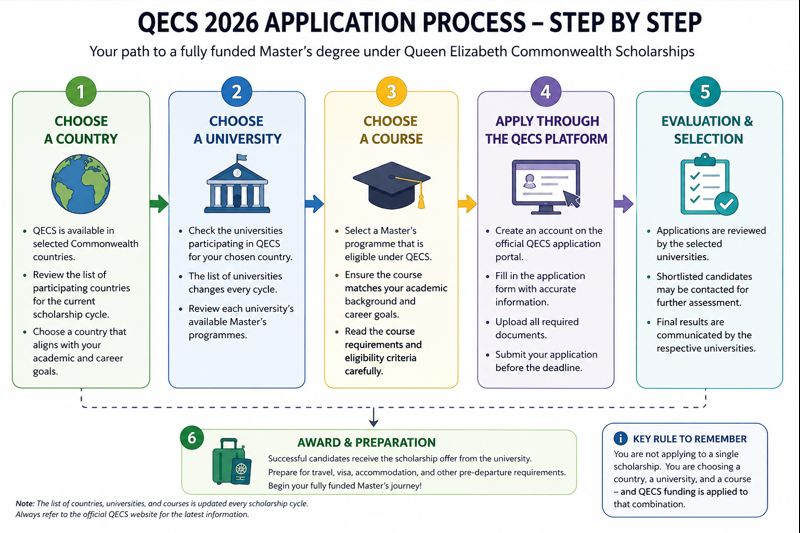
Key Rule
You are not choosing “a scholarship.”
You are choosing:
→ a country
→ a university
→ a course
…and QECS funding is applied to that combination.
If you understand this process clearly, your application becomes focused and structured instead of random.
Queen Elizabeth Commonwealth Scholarships Universities List (2026)

The Queen Elizabeth Commonwealth scholarships universities list for 2026 is limited and changes every application cycle.
For the 2026 cycle, QECS includes only a small number of host countries and universities.
Confirmed QECS Universities (2026 Cycle)
Papua New Guinea
- Papua New Guinea University of Technology (Lae)
South Africa
- Stellenbosch University (Stellenbosch)
- Tshwane University of Technology (Pretoria)
Each of these universities offers specific master’s programmes only, not all courses.
Important: The List Changes Every Cycle
QECS does not have a permanent university list.
Each cycle:
- new universities may be added
- some universities may be removed
- available courses may change
This is why you should always check the official QECS portal before applying.
What This Means for Applicants
You cannot apply broadly.
You must choose:
→ one country
→ one university
→ one eligible master’s programme
If your chosen university or course is not listed in the current QECS cycle, you cannot apply for funding through QECS. you can also explore country-level options through Fully Funded Scholarships 2026.
Why the List Is Limited in Queen Elizabeth Commonwealth Scholarships
QECS focuses on:
- low and middle income Commonwealth countries
- specific academic partnerships
- selected programmes aligned with development goals
This is why countries like:
- UK
- Canada
- Australia
are not included.
What You Should Do Next
Instead of searching for a general list:
- check the current QECS cycle
- review participating universities
- shortlist eligible programmes
- apply only to relevant options
This approach is far more effective than relying on outdated lists.
What Queen Elizabeth Commonwealth Scholarships Covers (2026)
The Queen Elizabeth Commonwealth Scholarships 2026 fully funded package covers the essential costs of a master’s degree—but it is important to understand what “fully funded” actually means in practice.
QECS is designed to support your core study expenses, not every possible cost.

What Is Covered
QECS provides a structured funding package that includes:
- Tuition fees
Your full tuition is covered through a combination of QECS funding and host university support. - Monthly living stipend
A regular stipend is provided to cover basic living expenses such as accommodation, food, and transport. - Return airfare
One economy-class return ticket from your home country to the host country. - Arrival allowance
A one-time grant to help with initial costs after arrival. - Research support (limited)
In some cases, additional funding may be available for thesis or research-related expenses.
Queen Elizabeth Commonwealth Scholarships Stipend Amount
The Queen Elizabeth Commonwealth Scholarships stipend amount is not fixed globally.
Instead:
- each host university sets its own monthly rate
- the amount depends on the country’s cost of living
This means:
- in some countries, the stipend comfortably covers expenses
- in others, you may need to budget carefully
The goal is to cover basic living needs, not luxury or savings.
What “Fully Funded” Does NOT Cover
This is where many applicants misunderstand QECS.
The scholarship does not cover:
- accommodation directly (you pay rent from your stipend)
- family or dependent expenses
- personal or luxury spending
- additional travel beyond the provided ticket
- miscellaneous costs like visa fees or extra materials
QECS is a functional funding model—it removes major financial barriers, but it does not eliminate all costs.
What This Means for You
Before applying, you should:
- compare the stipend with the cost of living in your chosen country
- check accommodation options near your university
- plan for additional expenses not covered by QECS
- choose your country and university based on both academic and financial fit
Understanding this early helps you avoid unrealistic expectations and make better decisions.
Queen Elizabeth Commonwealth Scholarship 2026 Deadline
The Queen Elizabeth Commonwealth Scholarship 2026 deadline (Cycle 2) is:
→ 3 June 2026 (15:00 UTC)
All applications must be submitted before this time through the official QECS platform. Late applications are not accepted.
QECS Application Cycles Explained
QECS runs two application cycles each year, and each cycle includes different countries, universities, and programmes.
Cycle 2 (2026–2027 Intake)
- Opens: April 2026
- Deadline: 3 June 2026
- Study start: Late 2026 or early 2027
Cycle 1 (Expected)
- Opens: November–December 2026
- Deadline: January 2027 (approximate)
- Study start: Mid–late 2027
Each cycle is separate, and available universities change every time.You can also explore currently open opportunities through Scholarships Still Open 2026.
Important Rules You Must Know
- You must apply before the deadline — there are no extensions
- You must apply for a specific university and course
- You may also need to apply separately to the university
- Missing either deadline can make your application invalid
What You Should Do Now
If you are targeting QECS 2026:
- check available universities immediately
- shortlist your course early
- prepare documents in advance
- submit your application before the final week
QECS is competitive, and late preparation significantly reduces your chances.
Queen Elizabeth Commonwealth Scholarship Eligibility Criteria (2026)
To apply for the Queen Elizabeth scholarship for international students, you must meet strict eligibility requirements.
QECS is not a general scholarship. It is designed for applicants who clearly match the criteria.
Basic Requirements
You must:
- be a citizen of a Commonwealth country (or hold refugee status)
- apply to study in a different Commonwealth country (not your own)
- hold a bachelor’s degree with strong results (minimum 2:1 or equivalent)
- apply for a full-time, on-campus master’s programme
- meet the admission requirements of your chosen university
Important Restrictions
QECS does not support:
- undergraduate programmes
- PhD or doctoral programmes
- part-time or online courses
- study in high-income countries such as the UK, Canada, Australia, or New Zealand
If you are searching for a Queen Elizabeth Commonwealth Scholarship for undergraduate, this programme is not suitable.
What Strong Applicants Look Like
Meeting the minimum criteria is not enough.
Successful applicants usually have:
- a clear academic background related to their chosen course
- a defined study or career direction
- a strong reason for choosing a specific country and university
QECS selection is based on profile fit, not just eligibility.
Key Rule
Do not apply broadly.
Apply where your profile clearly matches:
→ the country
→ the university
→ the programme
If your profile does not align, your chances are extremely low.
How to Apply for Queen Elizabeth Commonwealth Scholarships 2026
Applying for the Queen Elizabeth Commonwealth Scholarships 2026 fully funded programme is a structured process.
You are not applying to a general scholarship pool—you are applying to a specific country, university, and master’s course.
Step-by-Step Application Process
Step 1: Choose a Country
Review the countries available in the current QECS cycle.
Choose a country that:
- offers programmes in your field
- matches your academic background
- aligns with your long-term goals
Step 2: Select a University and Course
Once you choose a country:
- review participating universities
- check eligible master’s programmes
- select one specific course
Only listed courses are eligible for QECS.
Step 3: Check Eligibility
Before applying:
- confirm you meet QECS requirements
- check university entry criteria
- review academic and language requirements
Do not apply if you do not meet the criteria.
Step 4: Prepare Your Documents
You will need:
- academic transcripts
- degree certificates
- references
- personal statement
Prepare everything before starting your application.
Step 5: Apply Through the QECS Portal
Submit your application through the official QECS platform.
Complete all sections and upload required documents.
Incomplete applications are rejected.
Step 6: Apply to the University (If Required)
Some universities require a separate application.
If required:
- apply directly to the university
- follow their deadlines
- include all necessary documents
Important Application Rules
- You must apply before the deadline — no extensions
- You must apply for a specific course and university
- Missing documents will result in rejection
- Only one QECS award can be granted
What Makes a Strong Application
Strong applications are:
- focused on one clear study path
- aligned with the chosen course
- realistic and well-prepared
Applying randomly reduces your chances.
Final Advice
Do not treat QECS like a mass application.
Choose carefully:
→ the right country
→ the right university
→ the right programme
Then build a focused application around that choice.
Reality Check: How Competitive Is QECS 2026?
The Queen Elizabeth Commonwealth Scholarships 2026 is a selective, course-specific master’s scholarship.
It is only available for listed universities and courses in low- or middle-income Commonwealth countries, and your application is assessed based on how well it fits your chosen course, institution, and programme goals.
Why Many Applications Fail
According to official QECS guidance, many applications do not progress because:
- applicants do not follow the instructions correctly
- applications are not aligned with the selected course or university
- candidates apply without clearly matching the programme requirements
QECS is not evaluated as a general scholarship.
It is evaluated based on fit.
What This Means in Practice
Even if you meet the eligibility criteria:
- you are not guaranteed selection
- you are competing with applicants who also meet the requirements
- your application must clearly match your chosen course and institution
This is why generic or unfocused applications fail.
Important Clarification
QECS requires you to apply to a specific university and course.
You may apply again in another cycle or to another country, but each application must be:
- separate
- targeted
- aligned with the selected option
The Practical Rule
Do not treat QECS like a general scholarship.
Treat it as a course-specific opportunity where:
→ your selection determines your chances
A well-aligned application has a realistic chance.
A misaligned application usually does not progress.
Who Should Apply for QECS 2026
Apply for the Queen Elizabeth Commonwealth Scholarships 2026 fully funded programme if your profile clearly matches the structure of the scholarship.
This programme is best suited for applicants who:
- are citizens of a Commonwealth country (or hold refugee status)
- are applying to study in a different Commonwealth country
- want a full-time, on-campus master’s programme
- meet the minimum academic requirement (2:1 or equivalent)
- are ready to choose a specific country, university, and course from the current QECS cycle
- can prepare a clear study plan explaining their course, university, and country choice
QECS works best for applicants who already have a defined academic direction.
Who Should Not Apply
Do not apply if your approach does not match how QECS works.
This programme is not suitable for applicants who:
- are looking for undergraduate or PhD funding
- are targeting part-time or online programmes
- want to apply without selecting a specific course and university
- are applying only because it is “fully funded” without a clear academic fit
- do not meet the minimum eligibility requirements
If your situation matches the above, your application is unlikely to progress.
Important Clarification
QECS requires you to apply to a specific university and course.
- You can submit more than one application
- But each application must be for a different country or university
- You can submit only one application per host university
Each application must be separate and fully aligned with the selected option.
Final Decision Rule
QECS is not about applying broadly.
It is about applying where your profile clearly matches:
→ the course
→ the university
→ the country
A well-aligned application has a realistic chance.
A misaligned application usually does not progress.
What Should You Do Next?
If you are serious about applying for the Queen Elizabeth Commonwealth Scholarships 2026 fully funded programme, the next step is simple:
Do not stay in research mode.
Move to action.
FAQs – Queen Elizabeth Commonwealth Scholarships 2026
Is Queen Elizabeth Commonwealth Scholarship fully funded?
Yes, it covers tuition, stipend, airfare, and basic living costs.
Can I apply to multiple universities under QECS?
Yes, but each application must be for a different country or university.
What is the QECS 2026 deadline?
The deadline for Cycle 2 is 3 June 2026 (15:00 UTC).
Is QECS available for undergraduate students?
No, it is only for master’s programmes.
Can I study in the UK under QECS?
No, QECS is only available in low and middle income Commonwealth countries.
Your Next Steps
Start with this sequence:
- Check the current QECS university list
Confirm which countries, universities, and courses are available in this cycle - Select one strong option
Choose a course that matches your academic background and goals - Review requirements carefully
Make sure you meet both QECS and university criteria - Prepare your documents early
Transcripts, references, and personal statement - Submit before the deadline
Do not wait until the last week
If QECS Is Not the Right Fit
QECS is highly specific.
If it does not match your profile, you should not force it.
Instead, explore broader opportunities:
- fully funded scholarships across multiple countries
- scholarships still open for 2026
- country-specific scholarship options
Final Rule
Do not apply blindly.
Choose one direction, build a strong application, and execute it properly.
That approach gives you a far better chance than applying randomly.
Official Source
For latest updates and application details: